
General Information
Living Species and subspecies
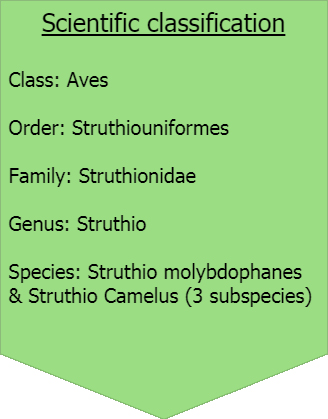
Struthio Molybdophanes (Blue neck Ostrich)

Struthio Camelus Camelus (Red Neck Ostrich)

Struthio Camelus Australis (Black Neck Ostrich)

Struthio Camelus Massaicus (Pink Neck Ostrich)

Extinct species
† Struthio dmanisensis
† Struthio camelus syriacus
†Struthio coppensi
† Struthio linxiaensis
† Struthio orlovi
† Struthio oldawayi
† Struthio wimani
† Struthio asiaticus
† Struthio brachydactylus
Geopraphic distribution

Natural Habitat
Today ostriches are only found natively in the wild in Africa. In the past, these birds habituated the middle-east and part of asia. They choose open arid environments such as savannas and semi-deserts like the Sub-saharan region.
Diet
Their diet consists mainly of leaves, seeds and roots, yet ostriches will eat whatever is available. Sometimes they consume insects, snakes, lizards, and rodents. As birds don’t chew the food, they swallow sand and small stones which grind up their food in an organ called the gizzard. An ostrich gizzard contains about 1Kg of stones that crushes the food.
Regarding intake of water, ostriches are very well adapted to dry land. They do not need to drink as long as they find food like leaves or roots. Meaning they can live for months without drinking.