
Mating season

The mating season begins in spring and lasts until late summer. It is at this time that females lay eggs and males exhibit a red color on the scales of their legs and on their beaks.
Dinosaur nest
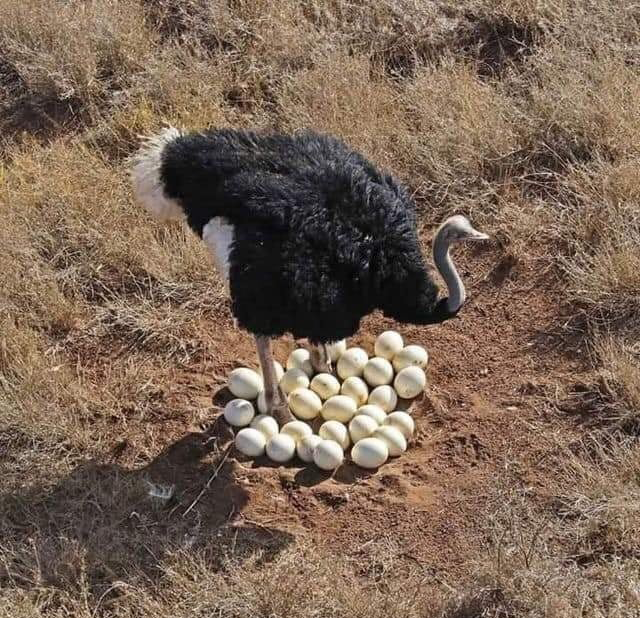
Ostriches are polygamous birds and form a communal nest, meaning that it is shared between the whole herd. The reason being that several males protect the same nest. It is the alpha male who builds the nest, which consists of a depression dug into the ground with the claws of its feet. The nest is very primitive and has no vegetable padding. A nest more like a dinosaur’s than a modern bird.

Team work

Males mark the territory of the herd producing a sound so loud and deep that it is sometimes confused by people with a lion. They also patrol the established territory around the nest and the females lay their eggs until the nest is full, with about 30 in total. Interestingly, the alpha male usually incubates the eggs at night and a female of his choice during the day. The shift change also usually coincides with sunrise and sunset. In this way, they camouflage the nest with the colors of their feathers.

Reproductive System
The reproductive system of the ostrich, like other ratites, is like that of a reptile and not a bird. That is why the males of these so primitive birds still have a penis in the cloaca, not like modern birds that do not have a penis. In short, their mating is more like that of turtles than that of pigeons.


Incubation
After 42 days of incubation, natural selection of this species arrives. Only the strongest chicks will be able to hatch the eggshell and this process can take a few more days. Only about 25% of chicks will be successful. At birth, the ostrich can see, walk and eat on its own. So they don’t need or even look for their mother. Instead they usually stick to the alpha male who is the best candidate for their protection. They also have a very effective camouflage for protection that confuses predators, as they resemble the african porcupine, a giant hedgehog capable of killing any animal that tries to eat it. These chicks grow very fast! From 15 centimeters to 2.10 meters in 10 months. Although at only 6 months of age they already measure 1.50 meters and run faster than a lion … at about 60km/h.


